Carlisle Castle
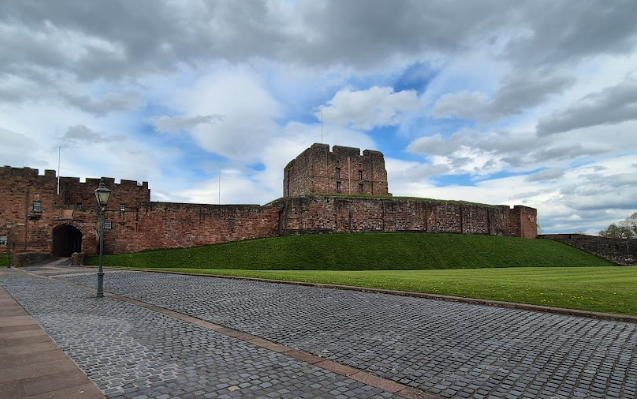
This castle in initally less imposing perhaps than some others you might find in the UK however its history is anything but. The city's location in the tumultuous Cumbrian region led to changing hands due to its desirous position for varying occupying forces. Referred to as "...the most besieged place in the British Isles, thanks to its strategic location on the English-Scottish border..." by HistoricUK, let's delve in.
The castle initially has its origins in the Roman occupation of Britannia. In AD72, a Roman fort was built where the current stone fortress stands. The fort aided the Romans by supporting garrisons along Hadrian's Wall and was a staging post into 'Scotland' (not known as such at the time). The town that developed around the fort was known as Laguvalium and was potentially the administrative centre of Rheged, one of the Romano-British kingdoms. The northern base was of great importance to the Romans whilst they continued to attempt to hold the south of the isle as well as push north however following their decreasing presence from the late 4th century onwards, the castle's use was less documented. There are tales linking King Arthur to the fortress - potentially holding court there - however, as with most Arthurian tales, it is hard to garner fact from fiction.
Following the Norman conquest of England, the castle began a long documented history. King William 'Rufus' II defeated the local Lord Dolfin in 1092 and established the castle over the old fortifications. The original was likely a ringwork castle made of earth and timber enclosures. This was later fortified after Henry I visited in 1122 and ordered it so. The keep as it is today possibly has its origins from this fortification although works on the castle continued after the death of Henry I when the castle fell in 1135 to David I of Scotland who, whilst friendly with the previous king of England and an oathed supporter of the Empress Matilda did not pass the opportunity to regain land for Scotland. King David had a prayer room in the keep that can still be seen (albeit from behind a clear wall and around the corner, as below) and he also passed from life in the Castle. It is possible that under David the works ordered by Henry I were finished and therefore the modern keep can be attributed to Scotland rather than England. What is known is stone from the 12th century makes up the oldest remaining structure.
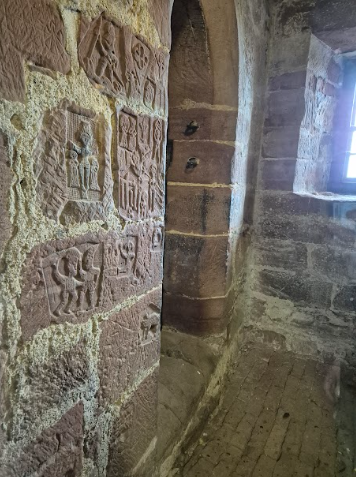
In 1186, Henry II ordered additions to be made that were potentially the start of the palace complex that can still be seen today. King John possibly had the inner wall rebuilt along with the inner ward wall done in stone in the early 13th century.
For 3 months the castle was occupied by Edward I and his forces who used the place as a staging ground for Edward's crusade against the Scottish. In order to make way for the court, additional housing and halls were added including an octagonal tower which would later become famous by association with one of its' occupants.
Between 1173 and 1461, the town and castle were besieged several times. Of note, in 1315 Robert the Bruce attempted to take the castle following his success at Bannockburn but in this he was unsuccessful. Then in 1461, the Scots allied with the Lancastrians and took Carlisle from the Yorkists during the War of the Roses.
The ensuing centuries, 15th and 16th, saw reivers, clans, and various groups taking advantage of the weak borders to raid and ravage neighbouring territories. Lord Wardens were appointed to combat the issue - 3 Lords for 3 Marches, the West of which was Carlisle. Richard, Duke of Gloucester and later King of England, one of the stars of the War of the Roses, was the most famous of Wardens and according to staff at the castle, it was in this role that Richard garnered some of his most fervant northern support. Prisoners held under Richard's authority made carvings on the wall of a cell in 1480 which can still be seen.
Henry VIII oversaw the largest building campaign on Carlisle since the 12th century. This was due to the renewed alliance between Scotland and France - the Auld Alliance - and Henry's war-mongering causing tensions between the two countries. This included events such as the rough wooing. Under this campaign the keep was lowered, the inner ward walls were thickened, and the half-moon battery was constructed.
Not long after, Mary Queen of Scots, upon abandoning Scotland under threat to her life, escaped to England and was housed in the octagonal Warden's tower, built under Edward but renamed henceforth Queen Mary's Tower. This was the last time the tower was used as a royal residence. Mary's status was unclear - captive or guest - but either way her experience seems to have been rather pleasant, as per usual for those of royal status. Mary stayed in Carlisle for a few months then spent the next 19 years being moved around various estates before her beheading.
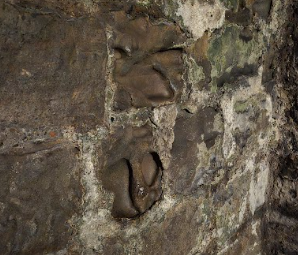
Mary was not the only prisoner the castle contained. Reiver prisoners were confined there, amongst whom was the infamous William Armstrong of Kinmont - Kinmont Willie - who was rescued from confinement with ladders wielded by his friends in 1596. During the Civil War crisis caused by Charles I, the Royalists held the castle but were essentially made prisoners. Surrounded by Parliamentarians in October 1644, the inhabitants nearly starved and were forced to eat the animals inside with them before finally surrendering after the Royalist cause was defeated soundly at the Battle of Naseby. Some of the last mediaeval action the castle saw was in the Jacobite Wars. On 9th November 1745 Prince Charles Edward Stuart - Bonnie Prince Charlie - led a force to besiege the castle and after 5 days the castle and city surrendered. The forces moved further south however they were pushed back without much resistance and a garrison of 400 men was left in charge of Carlisle while the rest of the force moved back over the Scottish border. In retaliation, the Duke of Cumberland's forces led the last siege at the castle, successfully taking it on 30 December 1745. 31 Jacobite prisoners were executed publicly while others were imprisoned. Whilst being kept in the cells under the keep, the Jacobites were deprived of food and water to such a degree that the men licked the walls in attempts to hydrate themselves via water dripping down. The depressions left by the repeated licking on the walls can still be seen today.
The castle was left largely unused until the 1820's when the government was in fear of revolution. Garrisons were maintained, Queen Mary's Tower was demolished in 1835, and army barracks constructed - at Carlisle these were the Gallipoli, Arroyo, and Arnhem blocks that can be seen outside the Keep (not their contemporaneous names clearly). The headquarters of the border regiment were established at Carlisle in the 20th century when the buildings continued to be extended. Today there is a small but thriving military museum detailing the modern military history of Carlisle and the wider border region.
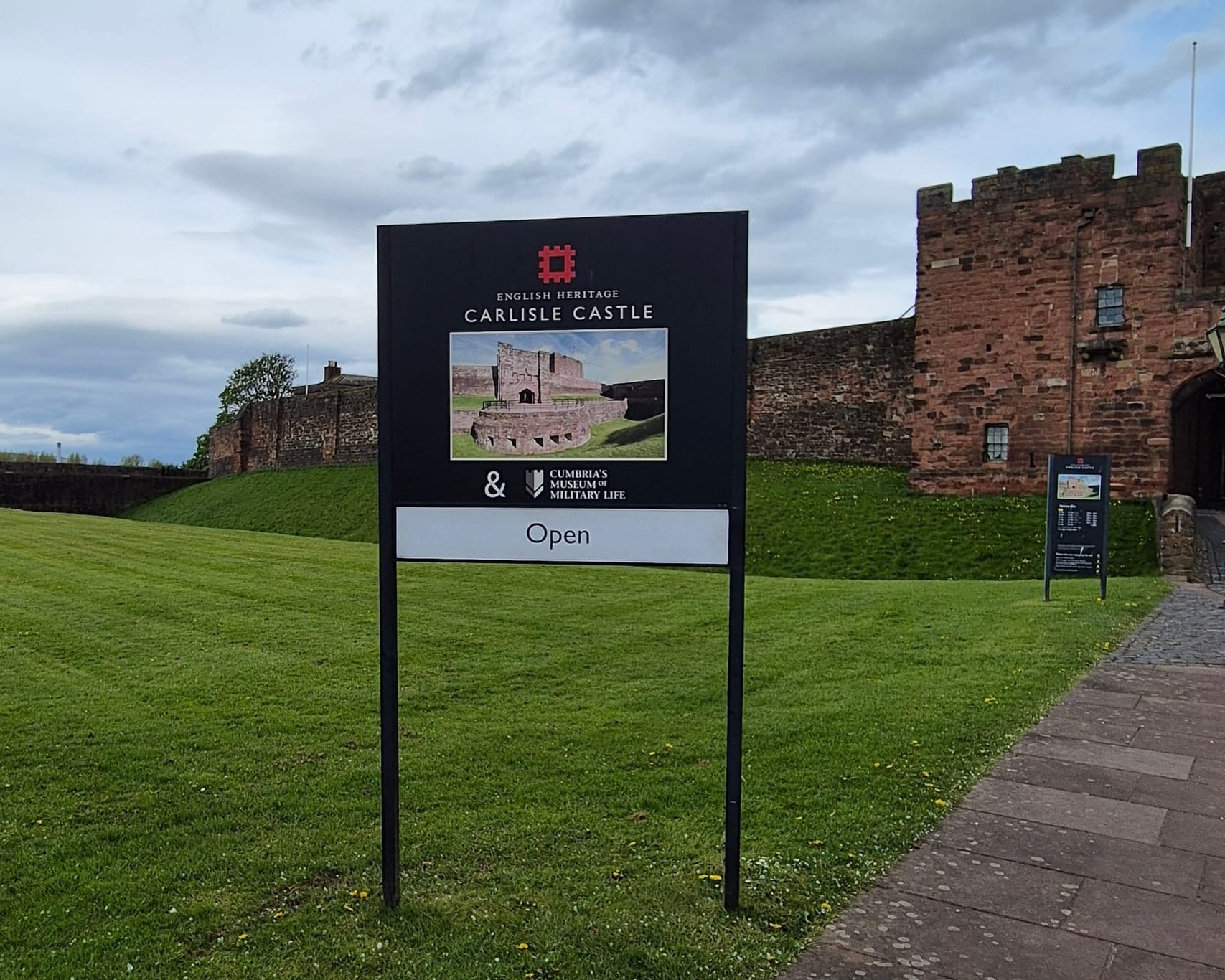
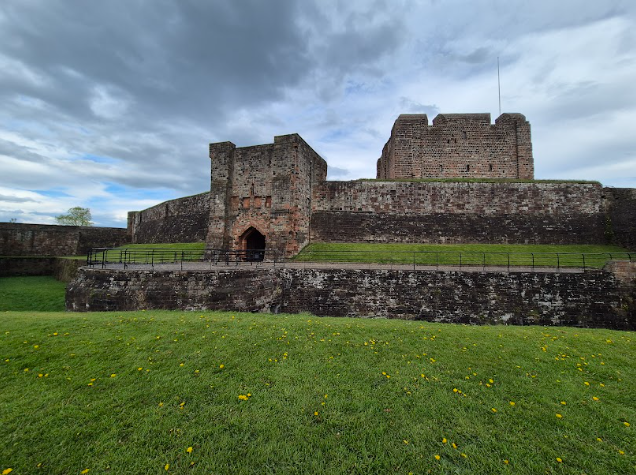
Carlisle Castle sits quite hidden initially from the Town Centre. Walking through the streets, even up to the Cathedral close-by, the Castle isn't obvious nor imposing ( atleast, not to me). However, as you walk up Castle Street, there's some history written into the pavement as you stroll up towards Tullie House, then you look up and there's a vast green lawn with the castle walls behind it, and the keep off to the right.
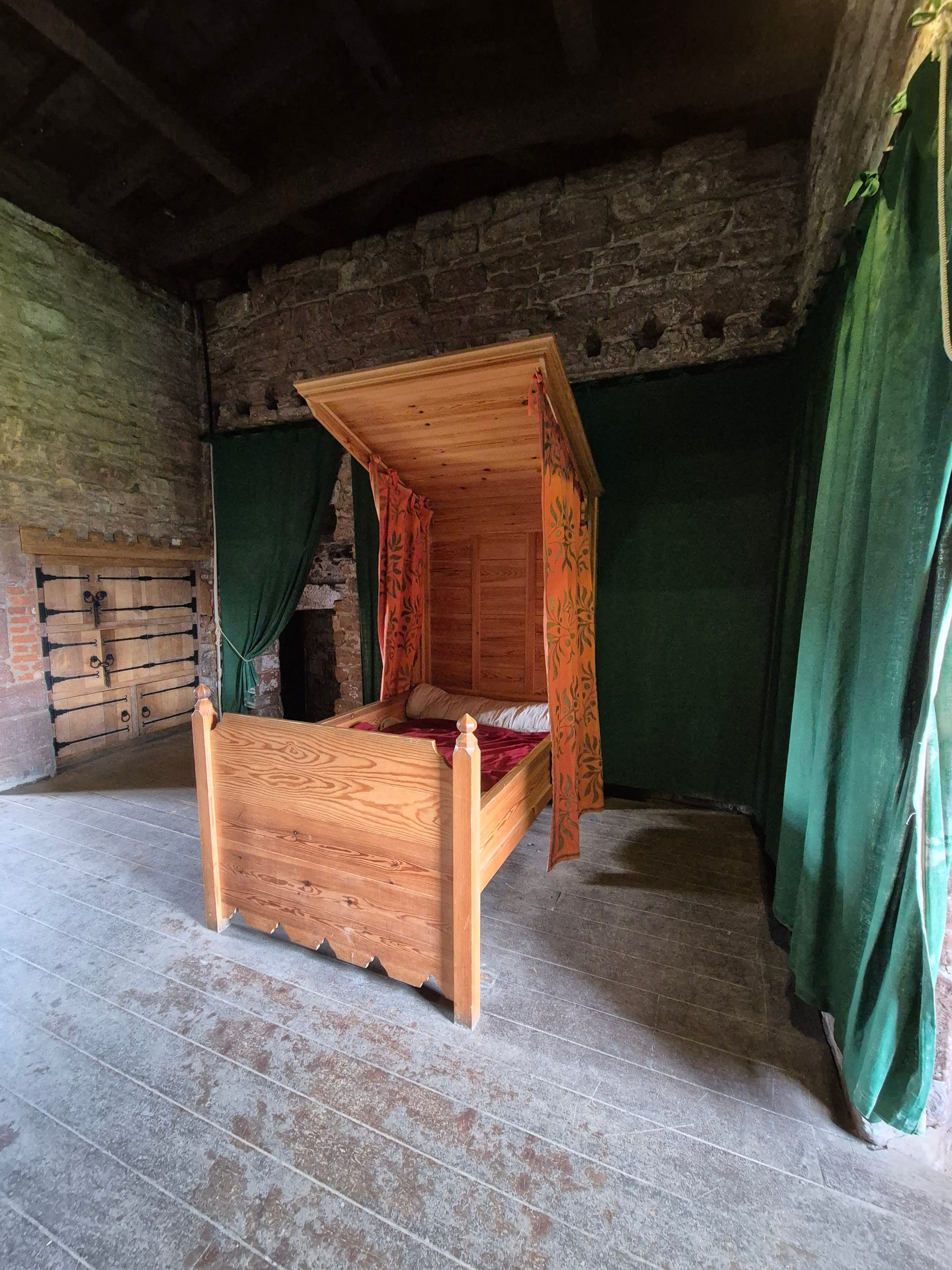
Even as you walk in, the Castle is still fairly unimposing. Walk up to the gate and there's a little shop / ticket office on the left. The staff are very friendly and give a good mini-introduction to the venue, including where to go and what's of interest in a couple of the places. Walk out the skinny glass door, turn directly left and you come up to the gatehouse which has been set up like a hall, then go through to a recreated bedroom. If you look carefully, there's a peephole through to the hall and you can imagine the plots that were listened to through there.
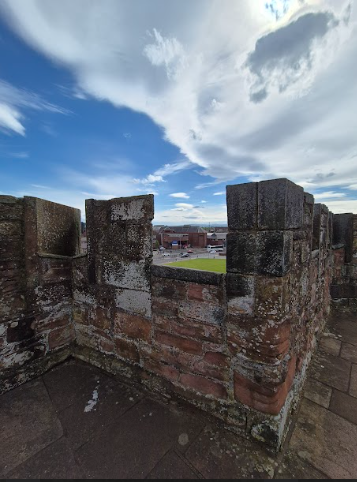
Once you come back out, it initially seems a little underwhelming however once you turn to the right and the sun comes out, the keep stands out with the half-moon battery in front of it. Walk up the cobbled drive and you can descend to the battery for a quick, mildly creepy dark experience, or you can continue on to enter the keep grounds. I chose to go up the guardhouse, the warden's quarters, to start with. This leads to a couple of basically unremarkable rooms however the real highlight comes at the top when you exit out a small door that leads to the keep ramparts. From there you can walk around almost 360 degrees and see Carlisle laid before your eyes. There are a couple of recreation cannons, fairly standard for most castles it seems. After walking around, you can descend a staircase and you are back in the keep courtyard.
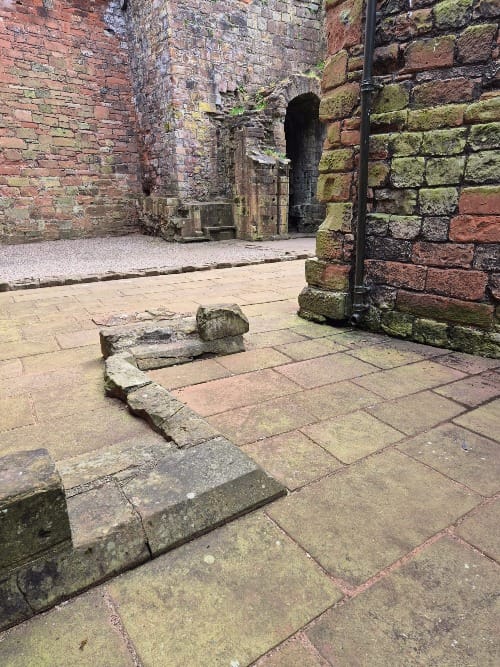
In the corner, there's a conspicuous empty section, made even moreso by doing the walk around first and looking down into the gap. A small sign lets the visitor know that this was the location of Queen Mary's Tower, where the famous Queen of Scots was held for a brief time. For myself, the small plaque was perfect in evoking a sense of loss both for the tower and for the Queen who lost her life.
After the Tower, or lack thereof, what was left to explore was the Keep itself. Upon entry there was a sign letting the visitor know what displays are on each floor. Deciding to descend first, it got instantly cooler and darker. On the left were 2 doorways, the first of which led to a small room all in darkness apart from 1 barrel of 'gunpowder' highlighted at the end of the room, thus proving you don't need signage to get across information. The subtle and evocative messages continue with the next room down. There is a small sign outside explaining that prisoners were held in that room - cell - and that evidence of their thirst could be seen in the depressions on some of the stones. To see them though you get plunged into almost utter blackness and cold and you feel, on some level, how terrifying it might have been. When you see and feel the depressed stone, it reinforces the struggle lightly outlined by the sign.
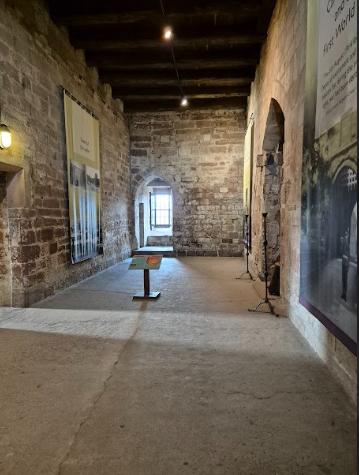
On the floor above, 2 large rooms have been draped in banners detailing the modern military use of Carlisle Castle. What is not immediately apparent but becomes so is that the hanging banners resemble the tapestries that might once have adorned the hall. Although the colours help the banners blend in moreso than tapestries would have, the continuation of subtle remembrances creates a flow between otherwise quite disconnected areas. The banners also present the most information in one place out of the whole Castle.
Floor 2 was the Constable's quarters, with a kitchen where you can still see the fireplace, then through to the next room where King David I's prayer room was and the etchings of prisoners and bored guards can be seen. As with Queen Mary's Tower, it was a little difficult to discern exactly what was what in this area. Signage stated King David had a prayer room however in the section where I expected to find an obvious prayer room was a wooden door and wall etchings made by bored soldiers guarding captives. Of course, these could have been at different times during the centuries with the etchings coming from the 15th century era of Richard, Duke of Gloucester and the prayer room of King David coming a couple centuries befor that. Despite this logic, it would have been helpful for a little more expounding from the signage on exactly where each place was,expecially with the actual side rooms themselves being blocked off in this section (understandably,t o protect the carvings). Even a little title on the map of the floor saying 'King David's Prayer Room/ later Prisoner Cell' would have maintained the minimalist style of the whole castle whilst causing less confusion. Confusion aside, the way the curators have balanced protecting the etchings whilst allowing people to see and enjoy them I think has been really well-done in this area.
The top floor was open but unfortunately had sustained water damage a few years earlier and its Jacobite exhibition had been removed. As of my visit (May 2024) there are no definitive plans for replacement although the Castle staff thought there might be a more generalised mediaeval use of the Castle exhibition in the future.
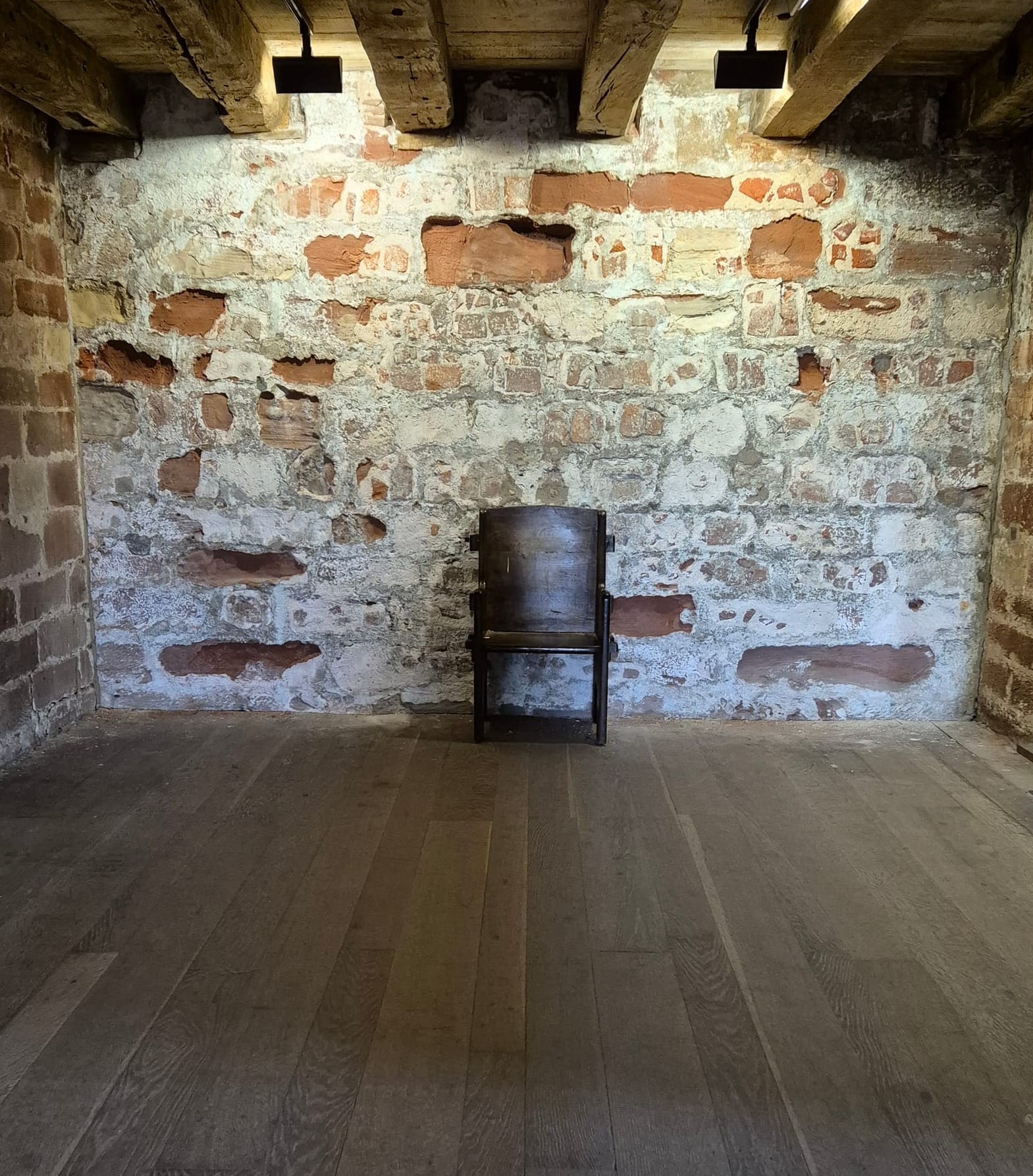
The overall impression of the Castle was one of utility, remembered through select evocations of the past. There are perhaps a few too many unknows, maybes, and speculations about the exact times and uses of the Castle for my liking but despite it being quite an important stronghold, it's relatively small and it's near-continual use makes it likely bits have been lost along the way for progress' sake which although sad is understandable. The Castle was always used as a military base and although at times it housed royalty and asscoiated courts, its utilitarian use was always there and the way it is presented today is a nice indication of that. The lack of signage initially was quite disconcerting, especially as I was looking to do some research on the place, but it was actually refreshing as it allowed me to know enough to understand the context of the areas I was in before allowing me to purely take in the environment, and experience. Areas such as the prisoner cell, the great hall, and to a lesser extent Queen Mary's Tower, were presented really well to connect the visitor to the past and added a particular quality to the experience that was wholly unexpected.
TIME: I spent 2 hours in the Castle, and 30 minutes at the War Museum however the Musuem could easily take 1 hour or more if you're interested in modern warfare and/or want to play all the games.
ABILITY: Not disability friendly except for the War Museum and the ground levels that I could see. There are a few windy staircases in the Keep but they aren't too bad as long as you keep an eye out for people coming down or up near you and you'll have to plaster yourself to the wall to let them by.
FACILITIES: Cafe, Toilets, Gift Shop. Staff in the gatehouse gift shop available for questions.
Sources:
- Carlisle Castle information
- English Heritage
https://www.english-heritage.org.uk/visit/places/carlisle-castle/
https://www.english-heritage.org.uk/visit/places/carlisle-castle/history/
-Historic UK
https://www.historic-uk.com/HistoryMagazine/DestinationsUK/Carlisle-Castle/